
Orthodontic treatment is one of the few areas of dentistry where the patient genuinely has meaningful choices. Metal braces, ceramic braces, and clear aligners each have distinct strengths, and the right choice depends not just on your clinical situation but on your lifestyle, age, budget, and the level of responsibility you are willing to take on. At Al Jurf Medical Center in Ajman, our orthodontists take the time to present every option honestly and help you make a decision you will feel confident about.
What all orthodontic treatment shares is the core purpose: moving teeth into a position where they function better, are easier to keep clean, and where the bite distributes force evenly across the jaw. The cosmetic benefit of a straighter smile is real and significant, but it is the health outcome that makes orthodontic treatment worth the investment for people of any age.
Misaligned teeth are harder to clean. The tight, overlapping surfaces that a toothbrush and floss cannot reach become consistent sites of plaque accumulation, increasing the risk of interproximal decay and gum disease over time. Patients with significant crowding often develop cavities in the same predictable locations year after year until the alignment issue is addressed.
Beyond cleaning difficulty, bite misalignment distributes chewing forces unevenly. Some teeth take far more load than they should, leading to premature wear, cracks, and sensitivity over years and decades. Jaw joints and muscles compensate for an irregular bite, often resulting in TMJ discomfort, headaches, and facial muscle tension. Orthodontic treatment addresses all of these downstream consequences at the source.
Jaw joints and muscles compensate for an irregular bite, often resulting in TMJ discomfort, headaches, and facial muscle tension. Orthodontic treatment addresses all of these downstream consequences at the source.
Metal braces remain the most clinically versatile orthodontic tool available. Brackets bonded to the front surface of each tooth are connected by an archwire, and the combination of these forces — adjusted at appointments every four to six weeks — guide teeth into their correct positions over time.
Modern metal brackets are significantly smaller, smoother, and more comfortable than the braces your parents remember. Most patients adapt within two weeks, finding them far less intrusive than anticipated. Metal braces are the preferred choice for complex cases: severe crowding, significant bite correction, and cases requiring precise three-dimensional movement that cannot be reliably achieved with removable aligners.
Metal braces are also the most affordable orthodontic option, which makes them the choice of preference for families managing multiple children's treatment simultaneously.
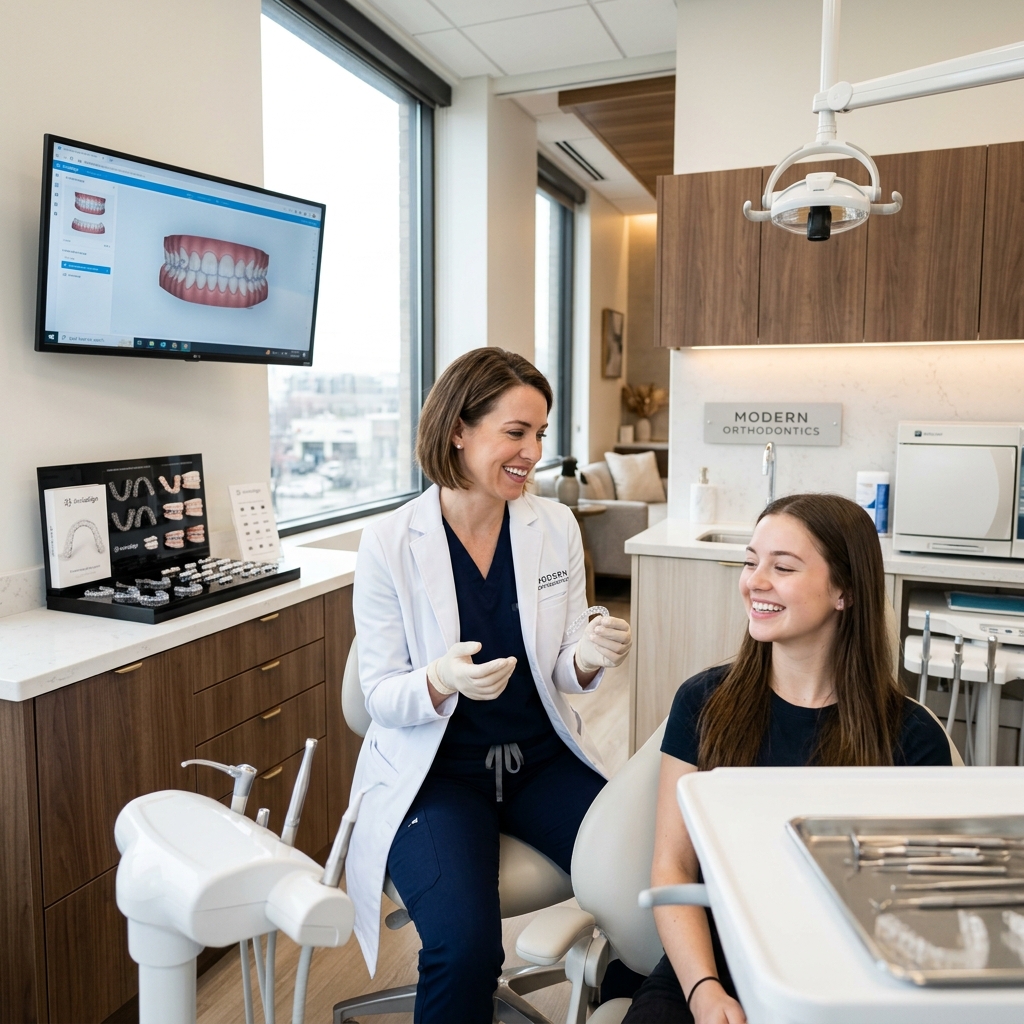
Clear aligners are a series of custom-fabricated, smooth, transparent plastic trays that fit precisely over the teeth and apply controlled forces to move them incrementally. Each tray is worn for one to two weeks before progressing to the next in the series. The total number of trays depends on the complexity of the case and the movements required.
Because they are virtually invisible when worn, clear aligners are particularly popular with working professionals, university students, and adults who want orthodontic treatment without the aesthetic impact of visible brackets. The ability to remove them for eating, brushing, and flossing is a genuine quality-of-life advantage.
The critical requirement with clear aligners is compliance. To achieve the planned movements on schedule, aligners must be worn for 20 to 22 hours per day. Patients who consistently remove them for longer than the prescribed window will experience delayed progress or results that do not match the original treatment plan. This is an important factor to consider honestly when weighing options.
In some cases, a combination approach is most effective: beginning with metal braces for the most complex movements and transitioning to clear aligners for finishing. Your orthodontist will discuss whether this applies to your case.
We guide you smoothly from consultation to a beautifully straight smile with consistent orthodontic supervision.
Your first appointment is an orthodontic consultation lasting approximately 45 minutes. Your orthodontist performs a clinical examination, takes digital photographs and dental impressions or an iTero intraoral scan, and reviews any relevant X-rays.
From this assessment, a detailed treatment plan is produced showing the proposed tooth movements, timeline, and options.
If you choose to proceed, fitting appointments for braces or delivery of your first set of aligners is typically scheduled within one to two weeks.
Your orthodontist monitors progress through regular appointments throughout treatment, and a retention phase follows the active treatment period to stabilise results long-term.
Orthodontic treatment is equally effective at any age, but the ideal timing varies. The recommended age for an initial orthodontic assessment is seven to eight years, when the first permanent molars have erupted. Early assessment does not always mean early treatment, but it allows issues to be identified and monitored, and in some cases, interceptive treatment can simplify later comprehensive treatment significantly.
Teenagers represent the most common orthodontic patient group. Adult patients in their 30s, 40s, and beyond make up a growing proportion of our orthodontic caseload, with many commenting that they wish they had done it sooner.
Contact us to schedule your 45-minute orthodontic consultation and get your personalized treatment plan.
Book AppointmentEverything you need to know about orthodontic braces and clear aligners at Al Jurf Medical Center.
Treatment duration ranges from 8 months for straightforward spacing cases to 2.5 years for complex bite correction. Your orthodontist will give you a personalised estimate after the initial assessment.
There is typically some soreness for two to four days after braces are first placed and after each adjustment. This is caused by the initial pressure on the teeth and resolves quickly. Soft foods and over-the-counter pain relief help during these periods.
There is no upper age limit for orthodontic treatment. Teeth can be moved at any age provided the gums and bone are healthy. We have patients in their 60s completing successful treatment.
With metal braces, brushing after every meal and using interdental brushes to clean around brackets is essential. Clear aligner wearers can remove their trays to brush and floss normally, which is a significant hygiene advantage.
Yes. Retention is the phase that protects your results long-term. Teeth have a natural tendency to drift back toward their original position. Wearing a retainer as prescribed prevents relapse and keeps your investment intact.