
If you are reading this with a throbbing toothache, jaw swelling, or a tooth that screams every time it touches something hot, you need two things: accurate information and prompt care. Root canal treatment is almost certainly the procedure your dentist is considering, and it is also almost certainly not as frightening as you have been led to believe. The reputation it carries belongs to a different era of dentistry. Modern root canal treatment, performed under local anaesthesia with current instruments and techniques, is not significantly more uncomfortable than having a filling placed.
What root canal treatment does is straightforward: it removes the infected or inflamed tissue inside your tooth, cleans and seals the canals, and gives your tooth a future. The alternative — extraction — creates a chain of problems that unfolds over years. At Al Jurf Medical Center in Ajman, our endodontists have performed thousands of root canal procedures. Here is everything you need to know.
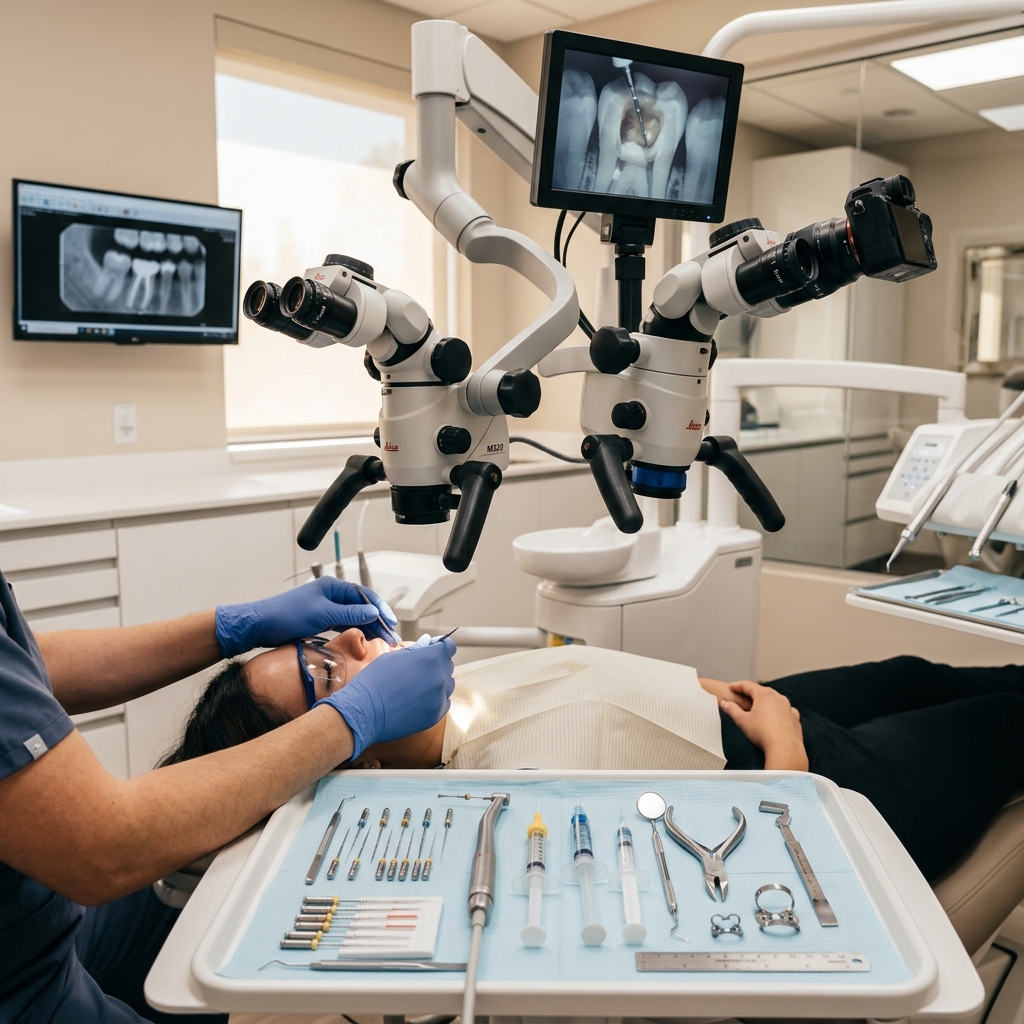
To understand why root canal treatment is necessary, it helps to understand what is inside a tooth. Beneath the hard enamel and dentine lies a soft tissue called the pulp, which contains nerves, blood vessels, and connective tissue. The pulp runs through the crown of the tooth and down narrow channels called root canals to the tip of each root.
During tooth development, the pulp is essential. Once the tooth is fully formed, it is no longer necessary for survival — the tooth can function perfectly well without it because it continues to receive nourishment from the surrounding tissues. This is why a root canal-treated tooth can last for decades, even a lifetime, when properly restored and maintained.
Once a tooth is fully developed, it is no longer dependent on the dental pulp for survival. It remains nourished by the surrounding tissues, allowing a root-canal-treated tooth to last for decades.
Root canal treatment is required when the pulp becomes infected or irreversibly inflamed. This can happen through several pathways:
In some cases, the pulp dies quietly with no pain at all. This is why dental X-rays at routine check-ups occasionally reveal infections in teeth that caused no symptoms. Silent infections of this kind can still progress and cause significant bone loss if left untreated.
Understanding the standard steps can alleviate apprehension and prepare you for your treatment visits.
Your dentist takes a digital periapical X-ray of the affected tooth to assess the extent of infection, the number and shape of the root canals, and any bone loss around the root tip. In complex cases, a CBCT 3D scan may be recommended for more precise canal mapping.
The tooth and surrounding gum are thoroughly numbed with local anaesthetic before any instruments are introduced. Our team takes care to ensure the area is completely numb before proceeding. If you feel any discomfort at any point, tell your dentist and additional anaesthetic will be administered immediately.
A small opening is made through the crown of the tooth to reach the pulp chamber. This is where the infected or inflamed tissue sits.
Using fine, flexible rotary instruments, the pulp tissue is carefully removed from each canal. The canals are simultaneously shaped and progressively widened to allow thorough disinfection. Copious irrigation with antimicrobial solutions removes bacteria and debris throughout this stage.
Once the canals are clean, dry, and confirmed free of infection, they are filled with a biocompatible rubber-like material called gutta-percha, sealed with a dental sealer, and the access opening is closed with a temporary or permanent filling.
The treated tooth requires a crown in most cases to protect it from fracture, particularly if it is a molar or premolar that bears significant biting force. Crown preparation is usually done at a separate appointment two to three weeks after the root canal, once the tooth has settled.
Some patients ask whether it is simpler to extract the tooth. Extraction is faster and often cheaper upfront, but the consequences unfold over years. When a tooth is removed, the jawbone in that area begins to resorb within weeks because the stimulation provided by the tooth root is gone. The teeth on either side gradually tilt into the gap. The opposing tooth over-erupts. Bite balance changes, placing excessive load on other teeth. Eventually, a bridge or implant becomes necessary — at significantly greater cost and complexity than the root canal would have been.
Root canal treatment, followed by a crown, preserves the original tooth, maintains the bone, and keeps the bite intact. It remains the gold standard recommendation over extraction for most cases.
When a tooth is removed, the jawbone in that area begins to resorb within weeks because the stimulation provided by the tooth root is gone. Saving the tooth prevents bone loss and maintains bite alignment.
Mild tenderness around the treated tooth for two to four days after the procedure is completely normal, particularly if the tooth was acutely infected. This responds well to standard over-the-counter anti-inflammatory medication such as ibuprofen. Chewing on the treated side should be avoided until the permanent crown is placed. Most patients return to normal activities the same day or the following morning.
Contact our reception to check availability. For patients in acute pain, we prioritize same-day or next-day appointments.
Book AppointmentEverything you need to know about the root canal treatment experience at Al Jurf Medical Center.
Most straightforward root canals are completed in 60 to 90 minutes. Multi-rooted teeth or cases with complex canal anatomy may require a second visit of similar length.
No. The tooth is fully anaesthetised before treatment begins. The discomfort people associate with root canals comes from the infection preceding treatment, not from the treatment itself.
Root canal treatment has a success rate of over 90% when performed by a qualified clinician and followed by an appropriate restoration. Properly restored and maintained root canal-treated teeth can last a lifetime.
Re-infection is possible if the crown seal is compromised or the root canal filling is incomplete. Regular dental check-ups allow any issues to be caught and addressed early.
In many cases, yes. For patients in acute pain, we prioritise same-day or next-day appointments. Call our reception to check availability.