
Microneedling has become one of the most consistently effective and widely requested aesthetic treatments available, and for good reason. The fundamental principle is elegant: create precisely controlled micro-injuries in the skin to activate the body's wound healing cascade, stimulating the production of new collagen and elastin. The result, across a course of treatments, is skin that is genuinely denser, firmer, smoother, and more evenly toned — not through resurfacing the surface, but through rebuilding the structural foundation beneath it.
The challenge for patients researching microneedling in Ajman is that the term now covers two distinct technologies with meaningfully different applications: standard Dermapen microneedling and radiofrequency (RF) microneedling. Understanding the difference between them determines which one will actually address your concern and deliver the results you are looking for.
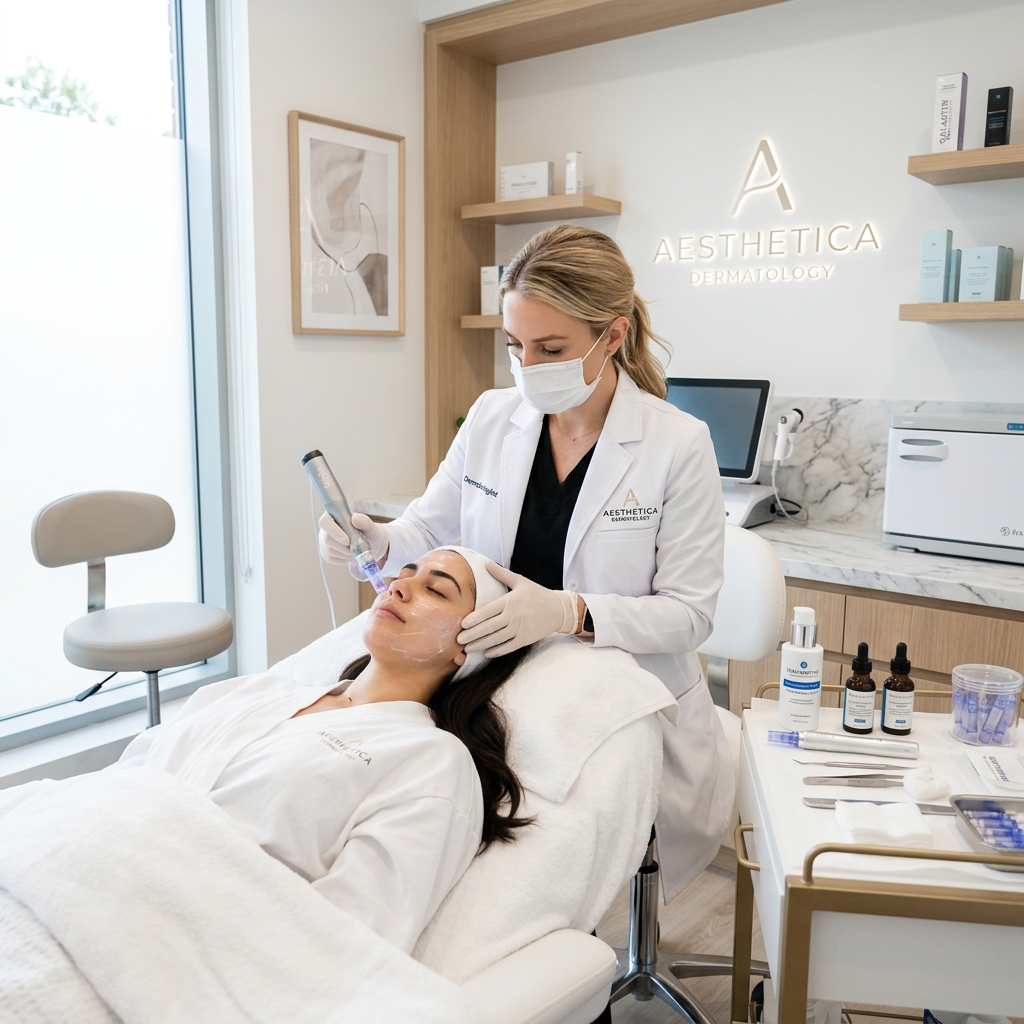
When fine needles penetrate the skin at a controlled depth, the body registers this as a micro-wound and initiates repair. Fibroblasts are recruited to the site and begin synthesising new collagen and elastin. Growth factors are released. The remodelling process unfolds over weeks and months following the treatment, which is why results from a course of microneedling continue to improve long after the last session.
The depth of penetration varies with the concern being treated. Surface-level texture issues are addressed at shallower settings. Deeper scars and more significant structural changes require deeper penetration into the dermis where fibroblast activity is most productive.
Deeper scars and more significant structural changes require deeper penetration into the dermis where fibroblast activity is most productive, leading to gradual synthesis of new collagen and elastin over weeks and months.
Dermapen is a motorised microneedling device that drives fine needles into the skin at controlled speeds and depths. It is the most versatile entry point for microneedling, effective across a broad range of concerns and suitable for all skin tones without the complexities that some energy-based devices introduce.
A topical numbing cream is applied 30 to 40 minutes before the session. The procedure itself takes approximately 30 to 45 minutes. Sessions are typically spaced four weeks apart, allowing a full cycle of collagen synthesis between each treatment. Most patients see meaningful results after three to four sessions, with full results visible at the six-month mark after completing a course.
Redness and mild swelling for 24 to 48 hours. Skin may feel slightly sensitive and tight for a day or two. Most patients return to normal activities the following day. Sun protection is essential for two weeks post-treatment.
RF microneedling adds a critical second mechanism to the standard microneedling process: radiofrequency energy. As the needles penetrate the dermis, they simultaneously deliver controlled RF heat directly into the tissue at a depth and intensity that cannot be achieved through topical application or surface-level devices.
The heat generated by the RF energy produces two effects. First, it causes immediate contraction of existing collagen fibres, producing a degree of instant tightening. Second, it creates a more intense stimulus for new collagen production than needling alone, resulting in significantly greater structural remodelling over the following months. The combination means RF microneedling addresses both skin texture and skin laxity in a single treatment.
The numbing process is the same as for Dermapen. The procedure itself takes 45 to 60 minutes. Sessions are typically spaced six to eight weeks apart, as the RF-induced remodelling process takes longer than standard microneedling. Most protocols involve two to three sessions, with results continuing to improve for four to six months after the final treatment.
Redness, swelling, and mild skin sensitivity for two to four days, slightly more pronounced than with standard microneedling due to the thermal component. Pinpoint bruising is occasionally present. Most patients are comfortable returning to work in two to three days.
The practical distinction is this: if your primary concern is skin texture, surface scars, large pores, or general dullness, Dermapen microneedling is an excellent starting point with a very favourable outcome profile. If skin laxity is in the picture — whether early or moderate — or if you have deep structural scarring that has not responded to standard microneedling, RF microneedling will deliver more significant results.
Many patients begin their journey with Dermapen and progress to RF microneedling as their goals evolve or as they see what standard microneedling achieves and want to push further. Your dermatologist at Al Jurf Medical Center will give you an honest assessment based on your specific skin and tell you clearly which treatment is most likely to deliver a meaningful improvement for your concern.
Important: Microneedling should never be performed during an active breakout. Patients with active acne, active cold sores, or very recent sun exposure in the treatment area should reschedule. Our team will advise appropriately at your consultation.
Contact us to schedule your microneedling consultation. Expert Dermapen & RF microneedling treatments.
Book AppointmentEverything you need to know about Dermapen and RF microneedling at Al Jurf Medical Center.
Yes. Unlike ablative laser resurfacing, microneedling does not target melanin and is safe for all Fitzpatrick skin types, including the darker skin tones common in the UAE and South Asian communities.
For Dermapen: typically four to six sessions. For RF microneedling: two to three sessions are usually sufficient. Individual treatment plans are discussed at your consultation.
Yes. Microneedling is frequently combined with platelet-rich plasma (PRP), vitamin infusions, or hyaluronic acid serums to enhance results. LED light therapy post-treatment accelerates healing and reduces redness. Your dermatologist will advise on the most effective combination for your goals.
Initial improvements in skin texture and tone become visible after one to two sessions. Full results from a course develop progressively over four to six months as collagen remodelling matures.
Yes. Dermapen microneedling has a good evidence base for improving the appearance of stretch marks, particularly newer ones. Results are gradual and multiple sessions are needed. Your dermatologist will set realistic expectations at consultation.